


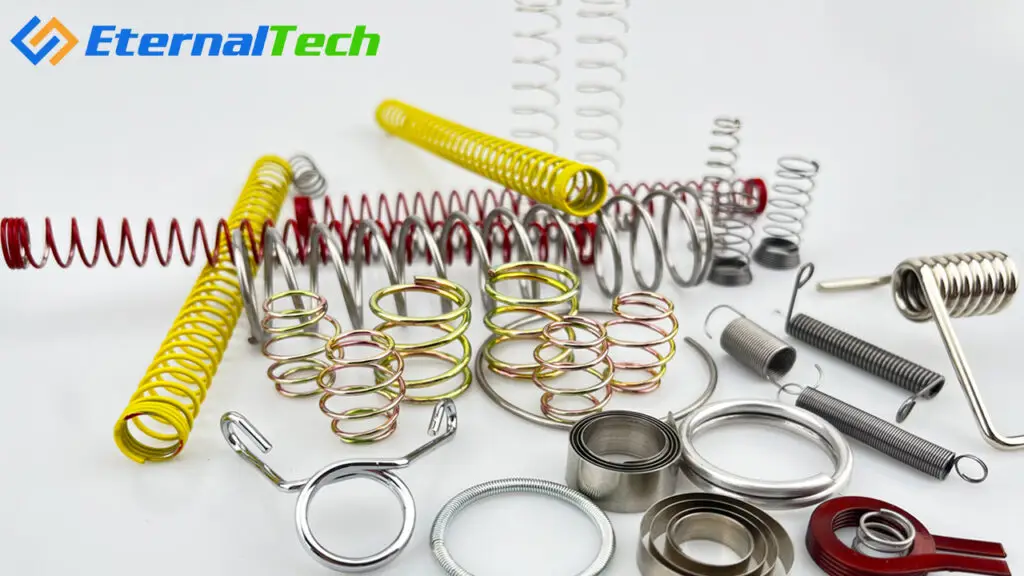
Springs are everywhere, you can find them used in commercial & industry, like watches, gun, mattresses, clutches, and even garage door systems. So, you may wonder how many types of springs and how they are made?
Before answering above questions, let’s find out what metal springs are.
Springs are elastic objects that store mechanical energy when subjected to tensile, compressive, bending, or torsional forces. They are also a key component of wire forming services ↗, especially in custom manufacturing.
Common Types of Springs
● Compression Springs: Also known as coil springs, are open-coiled steel wire in a variety of cross sections and forms for linear applications. They offer resistance to an axially applied compressive force, and are a big category under compression and die springs.

● Extension Springs: Also known as tension springs, store energy and exert a pulling force between two mechanisms. When mechanisms separate, the extension spring tries to bring them together again.

● Torsion Springs: These are designed and wound to be actuated rotationally and to provide an angular return force.Torsion springs are often used in garage door torsion spring replacement.

● Constant Force Springs: Manufactured from flat strip material and spooled to a specific curvature matching the needed pull force.

● Contact Springs: Typically conical or tapered, these are used for electrical conductivity, like in battery compartments.

● Wave Springs: Made from coiled flat wire with waves, allowing them to be more compact than traditional coil springs while offering the same force.

Spring Manufacturing Process (Taking Torsion Springs as Example)
1) Raw Material Inspection
Inspection and tests on metal wires of mechanical properties, appearance, dimensions etc., to determine or verify materials are met with specification or contract agreed.
2) Coiling
There are two ways to coil springs.
● Cold winding
The spring wire diameter d≤8mm can be coiled by cold winding. This can be done on a dedicated wire spring machine operated by a set-up program at room temperature. The wire is pushed forward over a support block toward a grooved head that deflects the wire, forcing it to bend. The head and support block can be moved relative to each other in as many as five directions to control the diameter and pitch of the spring that is being formed.
For extension or torsion springs, the ends are bent into the desired loops, hooks, or straight sections after the coiling operation is completed.
● Hot winding
Wire diameter d>8mm can be coiled into springs using this method. Springs coiled in a hot state must be quenched and tempered at medium temperature after coiling. Heated metal helps to increase wire’s flexibility.
3) Stress Relief and Tempering
The coiling process causes stress in the wire, to relieve this stress and allow the steel to maintain its characteristic resilience, reduces dimensional changes, the spring must be tempered by heat treating it. Heating the spring in an oven for a specific amount of time at a set temperature and then allowing it to cool slowly.
4) Surface Finish
Many spring coatings and spring surface treatments are available for metals. Some are primarily responsible for corrosion prevention while others are intended to improve the spring surface hardness or wear resistance. Spring coatings are also used to change dimensions (slightly) and to alter some physical properties such as reflectance and color.
● Electroplating
A process of using electrolysis to plate a layer of metal film to the metal surface, including chrome, cadmium, copper, gold, nickel, silver, tin, zinc plating etc.
● Chemical conversion coating
A chemical conversion coating is a coating that is produced by electrochemical or chemical reaction of metals, giving a superficial layer which contains the metal compound. It offers economical protection against corrosion and a surface suitable for powder coating and painting. Black oxide, phosphate coating etc are commonly applied.
● Electroless plating
A method of plating metal by chemical rather than electrical means, in which the piece to be plated is immersed in a reducing agent that, when catalyzed by certain materials, changes metal ions to metal that forms a deposit on the piece.
5) Quality Control
The tests include dimension measurement, appearance quality, mechanical properties etc with various testing devices to check completed springs in compliance with specifications.
6) Packaging
Pack springs with desired quantities in PE bags with carton, or according to customers’ requirements. No matter what kind of packaging, it is important to avoid any damage or tangling of springs. This applies to all types, including metal spring clip fasteners.
Why Choose Us
Xiamen Eternal Precision is a trusted wire form manufacturer offering precision wire forming and quality wire forming services tailored to your needs. Whether you are designing a spring for an aerospace project or looking for spring 2026 production planning, our team will help you find the most efficient and cost-effective solution.
Our custom capabilities cover wire form components and wire forming services that align with your part’s application and environment. Let us help you bring your idea into a functional and manufacturable design.